Published in the European Journal of Remote Sensing journal.
Code can be found at this repository.
Plain-language summary coming soon!
Abstract
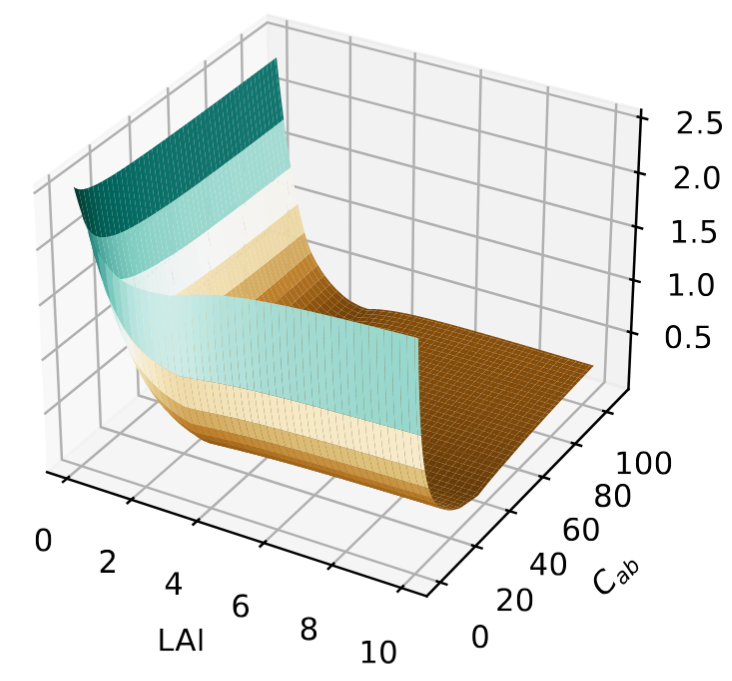
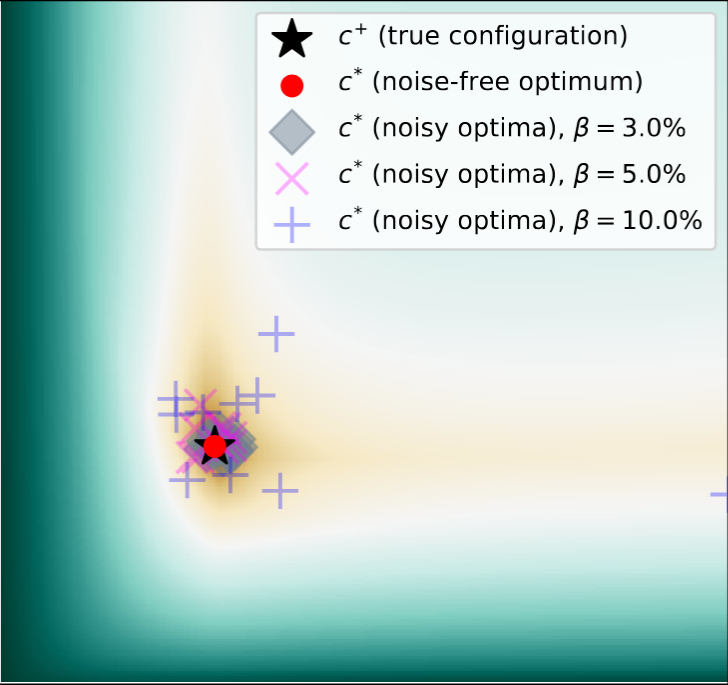
The inversion of PROSAIL, a radiative transfer model widely used for vegetation parameter retrieval, is often considered to be an ill-posed problem. However, beyond this general label, the ill-posedness and its characteristics are not well understood. This study aims to theoretically characterise the inversion problem and its ill-posedness in terms of its loss landscapes, and to analyse the impact of strategies reducing ill-posedness in terms of these landscapes. We carried out five empirical experiments from the perspective of numerical optimisation, allowing for a rigorous analysis of the inversion loss landscape. We found that PROSAIL inversion, on its own, does not meet a strict definition of ill-posedness, because i) there exists a solution to the problem, ii) the solution is unique, and iii) the outputs (parameter configurations) are continuous with respect to the inputs (spectral observations). However, our experiments show that both random spectral noise and spectral mixing, combined with a ‘plateau’-like spectral loss landscape, can explain ill-posed behaviour for the parameter retrieval tasks. We recommend a focus on data-centric approaches aimed at exploiting information complementarity in future work, as it appears unlikely that a model-centric focus alone will be able to overcome this type of ill-posedness in parameter retrieval.
Updates since publication
- None so far!